

The Medicare Trap Hidden in Every Severance Packet
When employees 65 and older are laid off, a chain of irreversible Medicare consequences begins — consequences the COBRA notice was never designed to explain.
The Medicare Puzzle
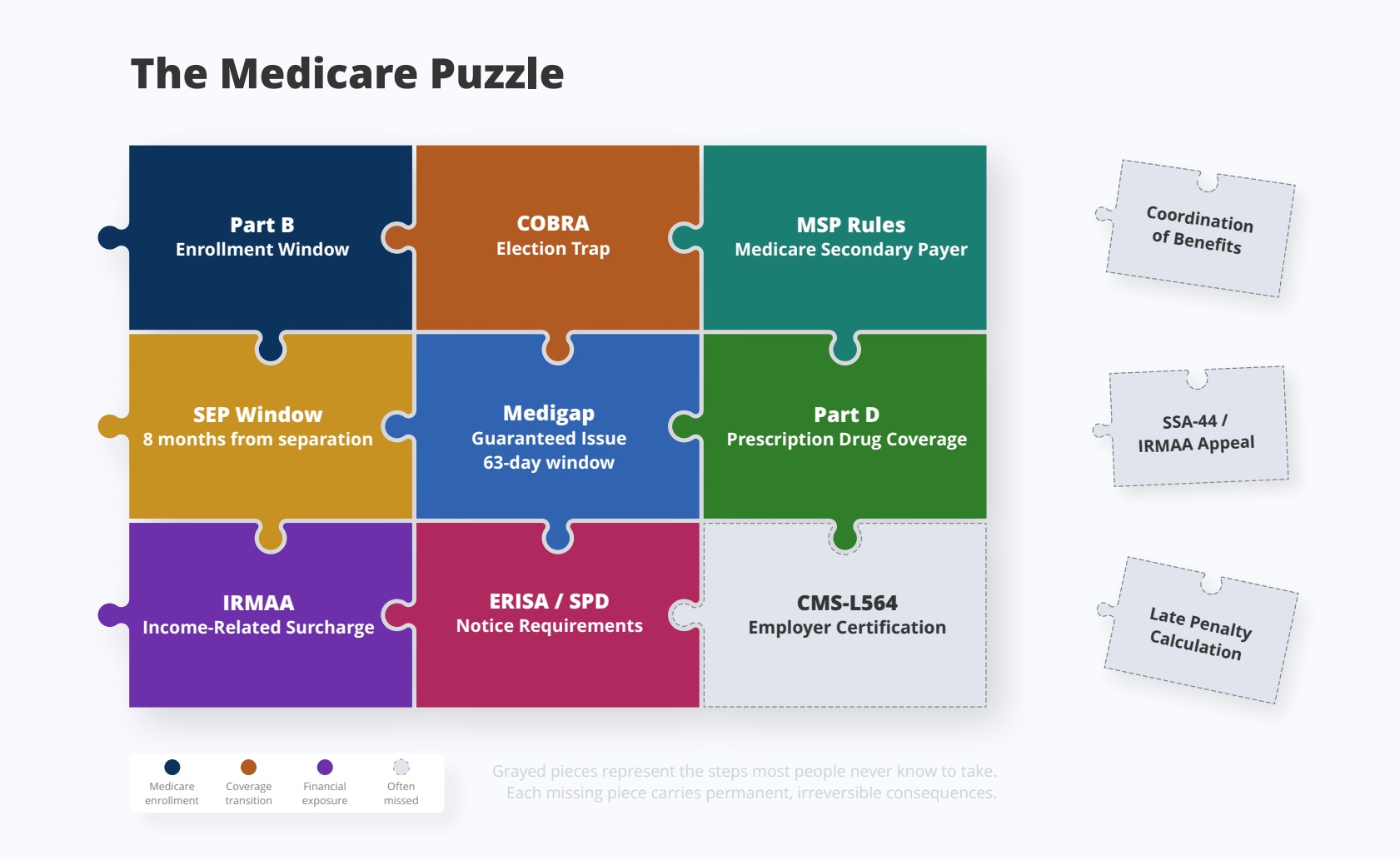
Every piece runs on its own clock — miss one, and the whole picture breaks.
The Problem Your COBRA Packet Doesn't Solve
Medicare enrollment is not complicated because the rules are obscure. It is complicated because the rules interact — and because every deadline is permanent. The eight-month Part B window, the 63-day Medigap window, and the Part D enrollment deadline run on separate clocks, none of them explained in a COBRA election notice. HR teams don't know them. Medicare and Social Security staff routinely get them wrong. The seven issues below are where the financial damage happens — and where it becomes irreversible.
Medicare Becomes Primary the Day Active Employment Ends
The moment active employment ends, Medicare Secondary Payer rules automatically shift payment order — COBRA does not preserve the prior arrangement. Claims the carrier has already paid can be retroactively denied months later, with the employee receiving a demand for repayment they never anticipated. By the time most people discover this, the appeals windows have already begun to close.
The 8-Month Medicare Part B Enrollment Window Starts at Separation — Not When COBRA Ends
The COBRA election notice says nothing about Medicare timing — and most employees over 65 assume eighteen months of coverage buys them time to sort it out later. It doesn't. The Special Enrollment Period for Part B is eight months from the date of separation, not from COBRA's expiration, and missing it means a permanent 10% premium penalty for every year of delay with no appeal and no correction until the following July.
Medigap Guaranteed-Issue and Part D Windows Run on Their Own Clock
When employer coverage ends, a 63-day Medigap guaranteed-issue window opens — after which insurers can deny coverage or impose surcharges based on health history. A separate Part D deadline runs simultaneously, adding a permanent monthly penalty for every month without creditable drug coverage. These two deadlines are independent of each other and of the Part B SEP — and missing any one of them cannot be undone.
IRMAA — Your Medicare Premium Is Based on Income You No Longer Earn
Medicare calculates Part B and Part D premium surcharges using tax returns from two years prior — meaning a separated employee whose income drops significantly at termination is automatically billed at their peak earning rate, sometimes for months, until they act. A single filer whose 2024 income exceeded $109,000 pays an IRMAA surcharge in 2026 regardless of whether they enrolled perfectly on time and regardless of what they earn today. The remedy is Form SSA-44, filed directly with Social Security to request recalculation based on current-year income after a qualifying life-changing event — but Medicare has no obligation to tell you it exists, and the surcharge reduction is prospective only, meaning every month of delay is money that cannot be recovered.
SPD and Notice Failures Carry Statutory Teeth
Under ERISA §502(c), failure to timely furnish the Summary Plan Description and required notices can cost up to $110 per day per participant; deficient COBRA notices add IRS excise taxes of $100 per day per beneficiary. These penalties compound across every affected employee and invite DOL and EBSA inquiry. Documented independent counseling delivered before separation is final gives the employer a meaningful good-faith defense if those penalties are ever assessed.
When Your Insurance Carrier Gets It Wrong
Active employees whose spouses or domestic partners are 65 or older sometimes receive claim denials — the carrier directing them to bill Medicare first. At companies with 20 or more employees, that denial may violate federal Medicare Secondary Payer law, not reflect a legitimate coverage decision. I help affected employees understand their rights, navigate the appeal, and — where the carrier's position is legally untenable — pursue remedies through the plan's ERISA dispute process.
Older Workers Benefit Protection Act
OWBPA requires that release agreements signed by separating employees 40 and older be knowing and voluntary — a standard courts scrutinize when a former employee later suffers financial harm. An employee who discovers a five-figure insurance clawback six months after signing has exactly the kind of grievance that puts them in an employment attorney's office. A properly counseled employee who avoids that harm is far less likely to become a plaintiff.
Medicare Transition Counseling for Separating Employees Age 64+
A defined-scope benefit attached to severance. Conflict-free: no insurance products are sold.
60–75 Minute Counseling Session
Covers the Part B clock, COBRA vs. Medicare economics, MSP primacy, Medigap guaranteed-issue rights, Part D, and IRMAA implications of severance income.
Written Personal Action Timeline
What to file, with whom, and by when — SEP enrollment, CMS-L564 employer certification, plan elections.
One Follow-Up Call
To confirm enrollments landed correctly.
Employer Documentation
Written confirmation that each affected employee received independent Medicare transition guidance.
| Engagement | Scope | Fee |
|---|---|---|
| Workforce Action | All affected employees 64+ in a single reduction in force or restructuring | $500 per employee ($5,000 minimum) |
| Standing Program | Ongoing coverage of all separations 64+, plus HR/benefits team briefing | Monthly retainer + per-employee fee |
| Individual Referral | Single-employee engagement referred by HR, counsel, or financial advisor | $600 flat fee |
Why MK Benefits Advisory
Thirty years in enterprise software sales — UKG, Oracle, Coupa, Blue Yonder — and firsthand experience on the wrong side of this exact failure. After my own separation at 68, I navigated a retroactive Medicare Secondary Payer claims reversal, Part B reinstatement, SSA enrollment disputes, and ERISA plan-document review with retained counsel. I have personally executed every filing I will be advising your employees to make — under real deadlines, with real money at stake.
“A properly counseled employee who avoids post-separation financial harm is far less likely to become a plaintiff.”

Planning a workforce action that includes employees 64+?
A 20-minute call will tell you whether you have exposure.
Prefer to pick a time now? Book a 20-Minute Call
Educational and administrative guidance only. No insurance products sold. Not legal advice.